
Brave new world

NOVEL
BRAVE NEW WORLD
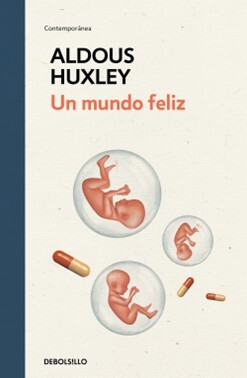
Description
In this visionary book written in 1932, the author envisions a dystopian society that uses genetics and cloning for the conditioning and control of individuals. In this futuristic world, where all children are conceived in test tubes and genetically conditioned to belong to one of five population categories, privacy has been suppressed in the name of stability and social control.
A Brave New World presents a society where each individual is subject to constant surveillance, with their life and actions monitored and manipulated by a totalitarian government. People are conditioned from birth to accept the invasion of their privacy as something normal, while individuality and freedom are sacrificed for the sake of collective well-being. Technology becomes an instrument of oppression, used as a tool to control and manipulate the masses, while the concept of intimacy fades in a world where personal information is weaponized to maintain the established order. In this context, the novel raises important questions about the ethical limits of state surveillance and the right to privacy.
A Brave New World depicts a dictatorship disguised as a democracy, a prison without walls where the prisoners would never dream of escaping—a grim metaphor for a possible future.
Synopsis
The worst predictions of capitalism have come true: the gods of consumerism and comfort reign supreme, and the world is divided into ten zones that appear safe and stable. Humans no longer procreate, sex has become merely a form of entertainment, and the letters of the Greek alphabet have been distorted to classify human beings into castes. Everyone accepts their place in the new, perfectly ordered social hierarchy.
The inhabitants are created in vitro using a technique modeled after an assembly line. Soma, the ultimate drug in Huxley’s dystopian world, helps people escape the monotony of daily life. Bernard Marx, the novel’s protagonist—intelligent and discontented—must test the limits of the society that has shaped him, embarking on a journey beyond the dystopian borders of his universe.
Best lines
“Individual freedom is sacrificed for the sake of the common good”
“Who controls the present controls the past, and who controls the past will control the future”
“That obsession with doing things in private, which in practice translates to doing nothing at all”
“A truly efficient totalitarian state would be one in which the all-powerful executive of political leaders and their army of administrators control a population of slaves who do not need to be coerced because they love their servitude”
“Lenina found it very unsettling. First of all, his obsession with doing everything in private. Because what could possibly be done in private?”
“Freedom to be inefficient and miserable; freedom to be a round peg in a square hole”
“But everyone belongs to everyone else”
Link to an excerpt from the novel for free distribution (Spanish)
© 1932, Aldous Huxley
© 1969, Penguin Random House Grupo Editorial, S.A.U. Travessera de Gràcia, 47-49. 08021 Barcelona
© Ramón Hernández, or the translation
Publishing license granted by Penguin Random House Grupo Editorial, S.A.U
https://www.penguinlibros.com/es/libros-clasicos/34502-libro-un-mundo-feliz-9788466350945?mot_tcid=a5226cb3-43c5-40ba-ad60-484f9f86248a
This post is related to other materials published by the Innovation and Technology Division of the AEPD, such as: